
Lower bills and backup power in one system
A hybrid solar system combines rooftop solar, a battery and the grid — managed automatically by one smart inverter. You save on your bill like an on-grid system, and your essential appliances keep running when the power goes out.
The best choice for homes and businesses that face regular power cuts.
- Backup during power cuts
- Net metering where allowed
- Subsidy-eligible setups
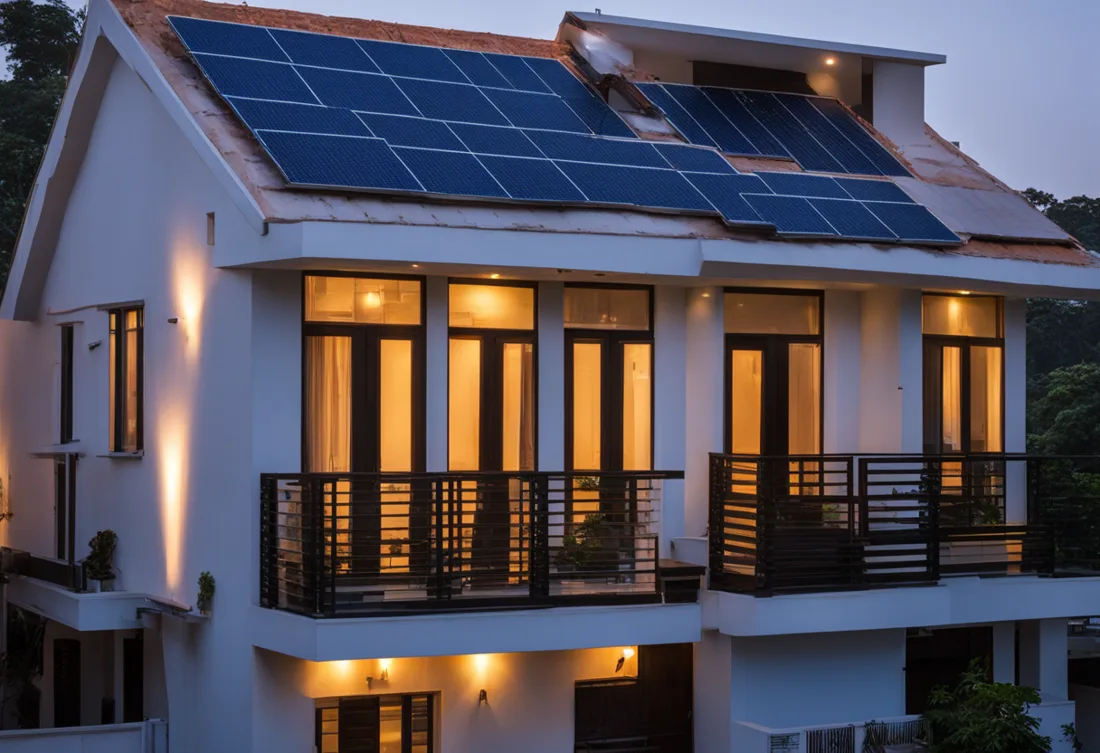
What is a hybrid solar system?
A hybrid system uses regular solar panels — what makes it “hybrid” is the inverter. It decides, second by second, whether to power your home from solar, the battery or the grid, and where to send surplus energy.
You can set it up to keep the battery in reserve for outages, or to use stored solar every evening and lower your bill even further.
- Bill savings of an on-grid system
- Battery backup of an off-grid system
- Reliability of a grid connection
Components of a hybrid system
Solar panels
High-efficiency modules that generate DC power from sunlight.
Hybrid inverter
Manages solar, battery and grid; converts DC to AC and charges batteries via built-in MPPT.
Battery bank
Lithium (LFP) batteries store solar energy for evenings and power cuts.
Net meter
Records units exported and imported where your DISCOM allows net metering.
Protection & cabling
DC/AC boxes, cables, MC4 connectors, earthing and lightning arrester.
Monitoring
See generation, battery charge and grid use live on your phone.
How a hybrid system handles every situation
On a sunny day
Solar powers your home first, then charges the battery. Any further surplus can be exported to the grid.
At night
The battery supplies your selected loads. When it reaches its set limit, the grid takes over.
During a power cut
The inverter isolates your home from the grid and runs backup circuits from the battery and solar.
When power returns
The system reconnects to the grid automatically, recharges the battery and resumes normal operation.
Benefits and limitations
Why choose hybrid
- Backup for essential appliances during outages
- Lower grid consumption and electricity bills
- Store daytime solar for evening use
- Automatic switching — no manual changeover
- Silent, fume-free alternative to diesel generators
- Can export surplus where net metering is allowed
Things to keep in mind
- Costs more than on-grid because of the battery
- Battery needs replacement during system life
- Longer payback than on-grid, typically 5–7 years
- Backup covers selected loads, not the whole house
On-grid vs off-grid vs hybrid
Not sure which system fits your home? Here’s how the three compare side by side.
| Factor | On-grid | Off-grid | Hybrid |
|---|---|---|---|
| Grid connection | Required | Not needed | Required |
| Battery | Not needed | Required | Required for backup |
| Power during a power cut | No — shuts down for safety | Yes, from battery | Yes, for selected backup loads |
| Net metering & export | Yes | No | Yes, if DISCOM allows |
| PM Surya Ghar subsidy | Yes | No | Yes, if net-metered |
| Upfront cost | Lowest | Highest | Medium to high |
| Typical payback | 3–5 years | 6–8 years | 5–7 years |
| Maintenance | Low | Higher (battery care) | Higher (battery care) |
| Best for | Reliable grid, lowest bills | No grid / remote sites | Frequent power cuts |
Payback periods are typical ranges and depend on your tariff, usage, sunlight and system design.
How we size a hybrid system
Solar, inverter and battery are sized separately — each answers a different question.
01Solar array: how much energy?
Based on your daily units, roof space and local sunlight. Roughly 1 kW generates about 4 units a day.
02Inverter: how much load at once?
Based on appliances running together, including the starting surge of fridges, pumps and ACs.
03Battery: how long will backup last?
Based on which appliances need backup and for how many hours during a typical outage.
How long will your battery last?
Example for a 10.24 kWh lithium battery bank (51.2 V, 200 Ah), with 85% usable capacity and 90% efficiency — about 7.8 kWh of usable energy.
| Connected load | What that looks like | Approx. backup |
|---|---|---|
| 500 W | Lights, fans, Wi-Fi, TV | ~15 hours |
| 1,000 W | Above + refrigerator | ~7.8 hours |
| 2,000 W | Above + water pump or microwave | ~3.9 hours |
| 3,000 W | Above + one 1.5-ton AC | ~2.6 hours |
| 5,000 W | Heavy loads, multiple ACs | ~1.6 hours |
Illustrative only. Real backup depends on battery age, temperature, starting charge, inverter losses and actual appliance consumption.
What should be on backup?
Putting only essential circuits on backup keeps your battery smaller and your system more affordable.
Great for backup
- LED lights and fans
- Wi-Fi router, laptops and phone charging
- Refrigerator
- Television and set-top box
- CCTV and security systems
- Selected power sockets
Better left off backup
- Geysers and water heaters
- Induction cooktops and ovens
- Room heaters
- Large pumps and motors
- Multiple air conditioners
- Heavy machinery
Why TPIL
Solar backed by 20 years of power expertise
Frequently asked questions
Is a hybrid solar system right for my home?
If you face frequent or long power cuts, work from home, or need backup for a fridge, medical equipment or security systems, hybrid is a great fit. If outages are rare, on-grid gives better returns.
Does a hybrid system work during a power cut?
Yes. The inverter disconnects from the grid and keeps your backup circuits running from the battery and any available solar.
Can a hybrid system use net metering?
Yes, where your DISCOM approves net metering for hybrid systems. If export isn’t allowed, the system can run in zero-export mode.
Does a hybrid system get the PM Surya Ghar subsidy?
A residential grid-connected hybrid system can qualify if it meets the scheme rules and your DISCOM allows net metering. The subsidy is capped at ₹78,000 and doesn’t cover battery cost.
Can a hybrid system work without a battery?
Many hybrid inverters can run without a battery like an on-grid system, letting you add batteries later. But you won’t get backup until a battery is installed.
Does a hybrid system generate electricity at night?
No — panels need daylight. At night you use energy stored in the battery during the day, or power from the grid.